
The 2026 Cannes Film Festival ran from May 12 through May 23. For ten days, most of the conversation focused on gowns, the famous steps, and stolen moments on the red carpet. That is part of the spectacle. But a less glamorous and far more practical question remains: what is left of a movie when some of what gives it meaning is never described?
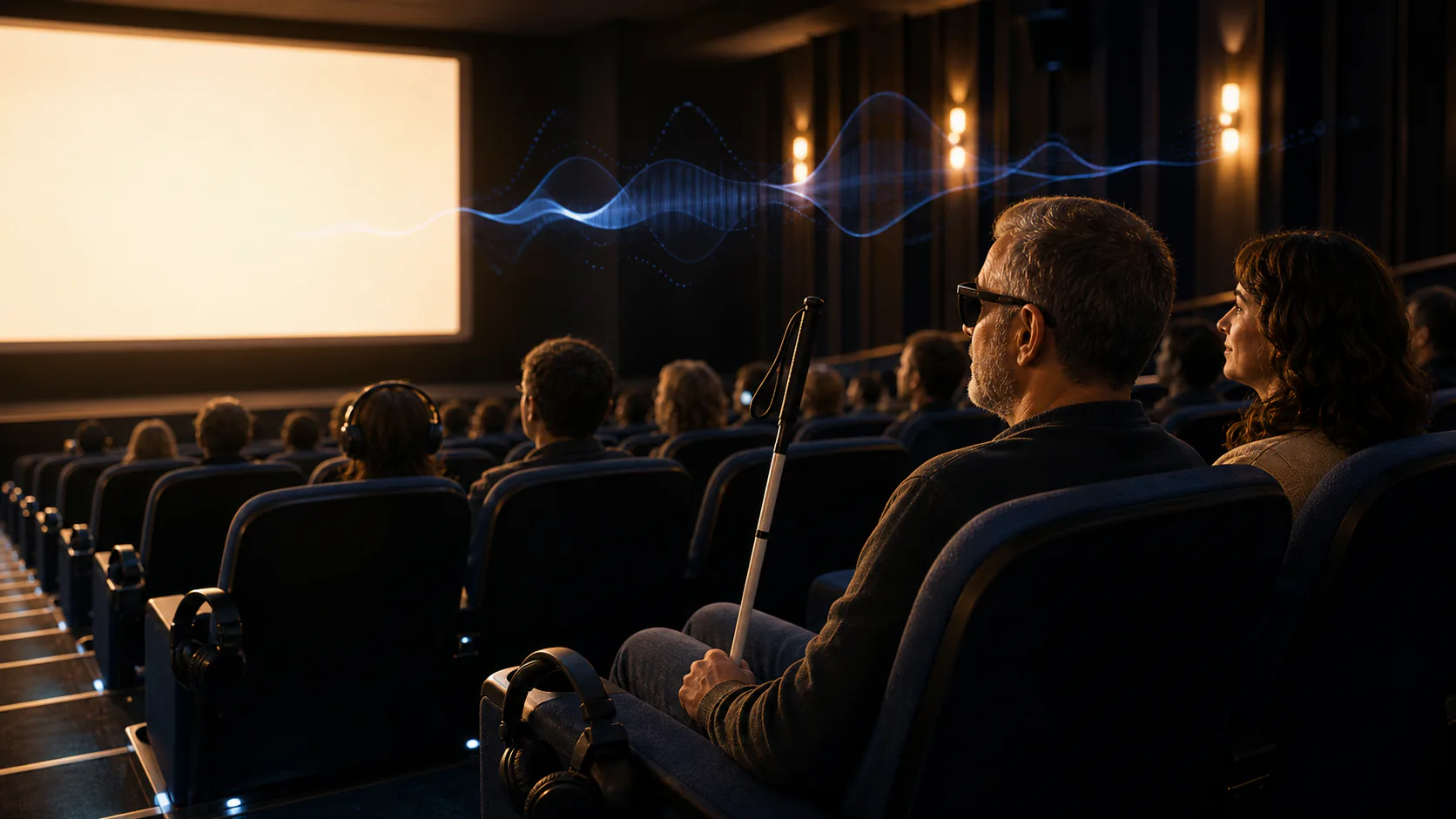
That is exactly what audio description is for. A spoken track fits between lines of dialogue to convey what the image shows and the soundtrack alone cannot explain: a face suddenly tightening, a hesitant hand, a door left ajar, or a setting that changes the mood of a scene.
Audio description is not a commentary layered over the work, and it is not a voice that must explain everything. Good description knows when to stay quiet. It chooses two words instead of ten, gives actors room to breathe, and respects the editing. When description is missing, however, a blind or low-vision viewer has to guess. Sometimes the clues are enough. Sometimes they are not. In those moments, the viewer is not missing attention; the viewer is simply missing part of the movie.
What audio description really changes.
Accessibility is often discussed as a checklist. In a movie theater, the experience is more fragile than that. It is not enough for an audio-described track to exist somewhere. The screening must be clearly identified, booking must work with a screen reader, the headset must be available and charged, its use must be explained, and someone must know what to do if it fails.
That is where the experience is decided: not in a press release, but at the box office. Not in good intentions, but when a moviegoer arrives and asks, “Is this screening definitely audio described?” If the answer becomes vague or awkward, or depends on one helpful employee being present, accessibility remains too fragile.
Cannes is a massive showcase built on ordinary details.
The French disability publication Faire Face made the point at the start of the festival: Cannes shows real attention to welcoming disabled attendees while specific barriers remain for people who are blind, have low vision, are Deaf, or are hard of hearing. That does not erase the work already done. It simply means accessibility is measured through use, not intent.
Progress is being made in France. The French National Center for Cinema and the country's Audio Description Portal both note that audio-description files and adapted subtitles are taking a more structured role in access to movies. That matters. For an individual moviegoer, though, the real test remains simple: can I choose this movie, on this day, at this theater, without conducting a small investigation before leaving home?
That is the right standard: booking the movie you want to see, not settling for “the accessible screening that happens to be available.”
Why this is not a secondary issue.
Going to the movies is not only about following a story. It means going out, hearing the audience react, talking afterward, and deciding whether you loved it or everyone else is exaggerating. It means being part of a shared conversation.
When a blind person has to check three websites, call the theater, ask someone else to confirm the information, and then hope the equipment works that day, the pleasure has already begun to wear thin. Audio description does more than provide access to images. It makes the act of going to the movies lighter, more ordinary, and less dependent on other people.
Technology helps, but it cannot replace a movie's voice.
Apps can already synchronize an audio-description track with a screening. AI is getting better at describing images, recognizing scenes, and reading visible text. Those capabilities are valuable in daily life: Lumyeye Pro can describe a photo, help read visual information, or launch a voice-powered web search when a page is difficult to navigate.
But a movie is not a sequence of images waiting for captions. Movie audio description requires writing. It requires rhythm, a voice, and restraint. It must understand what to say now, what to save for later, and what it must never talk over. Automation can help around the work. On its own, it cannot give the work its voice.
An open red carpet, in the fullest sense.
The entire movie industry watches Cannes. What becomes normal there can spread to other festivals, smaller theaters, streaming platforms, and distributors. Cannes cannot solve everything, of course, but it can make important standards visible.
Making movies accessible to blind and low-vision people is not about adding a technical option at the bottom of a listing. It means recognizing that their place is not beside the theater, after everyone else, or at an isolated screening. Their place is in the theater at the same time as everyone else, with the same basic right: to choose a movie and be swept up in it.
Before an audio-described screening.
A few checks can prevent common surprises:
- Confirm that the specific screening is labeled audio described, not merely “accessible.”
- Make sure the theater can explain how to pick up the headset or use the designated app.
- Ask whether staff can explain what to do if the audio does not start or synchronization fails.
Sources and references
- Faire Face, Cannes Film Festival accessibility report (French)
- City of Cannes, 2026 Cannes Film Festival (French)
- Cannes Film Festival, “A festival for everyone” FAQ
- French National Center for Cinema, Audio Description Portal (French)
- French Audio Description Portal, Understanding audio description (French)

Alban Clochet, Founder of Lumyeye. He designs voice tools to make reading, images, and digital services more accessible to blind and low-vision people.